Accurate electronic structure calculations of ground and electronically-excited potential energy surfaces for atmospherically important molecules
Current and Recent Projects:
- Potential energy surfaces for reactions of mercury with reactive halogens, e.g., Hg + {Br2, BrCl, BrO}
- Chemically-accurate thermochemistry for Hg- and Cd-containing species
- Electronic spectra of hydrogen peroxide-water complexes (with J. Francisco, Purdue Univ.)
- Potential energy surfaces for the O(1D, 3P) + HCl reactions including spin-orbit couplings
- Potential energy surfaces of HOBr for unimolecular decomposition and the photodissociation process HOBr + hv → OH + Br
- Spin-orbit effects in atoms and small molecules: {F, Cl, Br}, BrCl, BrO, and HOBr
- Accurate prediction of rotational-vibration spectra of OClO, OBrO, HOCl, and HOBr from accurate 3-D ab initio potential energy functions.
- Large-scale potential energy surfaces of HOCl for describing vibrational energy transfer leading to OH + Cl
This material is based upon work supported by the National Science Foundation under Grant Nos. CHE-9501262 and CHE-0111282
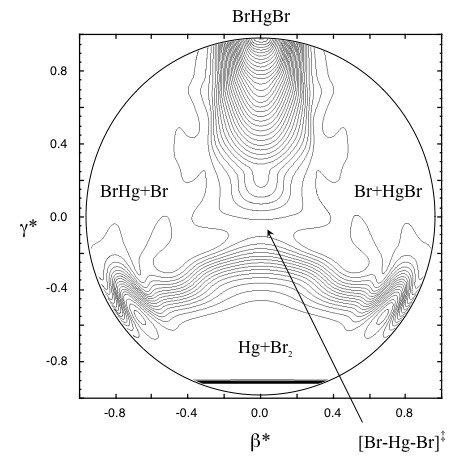
The global potential energy surface for the reaction of HgBr with Br features 3 reaction channels:
Recombination: HgBr + Br → HgBr2
Abstraction: HgBr + Br → Hg + Br2
Exchange: HgBr + Br → BrHg + Br
At 298K, the thermal rates are calculated to be fast and nearly equal for all 3 product channels. Oxidation of Hg by Br2 is calculated to be very slow at this temperature.
N.B. Balabanov, B.C. Shepler, and K.A. Peterson, J. Phys. Chem. A, submitted (6/05).
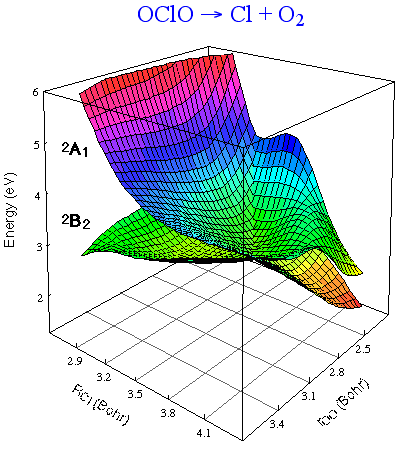
In the photodissociation of OClO,
two electronic states of the O2 product is observed: the ground and first excited states. Using large configuration interaction wave functions, 2-D portions of the exit channel were calculated to produce the figure at the right. The 2B2surface produces a1Δ O2, while the 2A1surface produces X3Σ- O2. The lateness of the crossing suggests that more a1Δ O2 will be formed, which is consistent with experiment.
K.A. Peterson and H.-J. Werner, J. Chem. Phys. 105, 9823 (1996).